
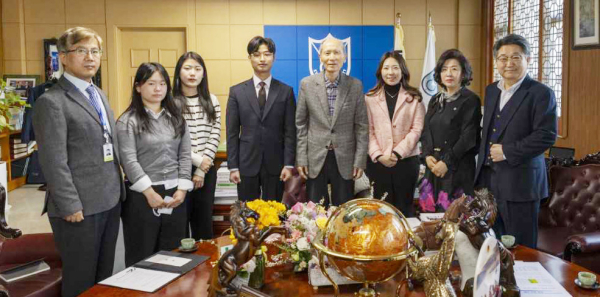
Kyungnam University (KU) celebrates its 79th anniversary this year, alongside the 68th anniversary of Kyungnam University Newspaper (KUN) and the 48th anniversaries of Kyungnam University Broadcasting System (KUBS) and the Kyungnam Times (KT). To commemorate these milestones, we conducted an interview with President Park Jae Kyu on April 2, 2025, in the President’s Office. Participants included Seo Sat-byul, Director of CUNP (Center for University News
and Press); Ku Kyo-cheol, General Manager of CUNP; and Han Haksun,Managing Editor of KT; Park Sung-han, Student Editor of KUN; Hwang Ji-woo, Student Director of KUBS; Hong Hye-ji, Student Editor of KT.
Q1 Despite fewer school-age students, KU had strong 2025 admissions. What are your strategies to boost competitiveness and attract students for 2026?
A1 KU achieved a 96.33% enrollment rate for the 2025 academic year. For 2026, we will enhance our overseas cultural experience program to strengthen global competitiveness and focus admissions efforts on key local areas through facultyled promotions, while targeting surrounding regions with fairs and information sessions.
Q2 How does KU evaluate recent project achievements and plan for future national initiatives like RISE?
A2 KU has successfully completed the University Innovation Support Project and received an “A” grade in the Regional University Vitalization Project. We are now focusing on securing participation in the RISE initiative and various national government projects. With the secured funding, we aim to strengthen our future competitiveness and expand our financial foundation.
Q3 In line with the AI (Artificial Intelligence) DX (Digital Transformation) era, KU is reforming its academic systems and diversifying course delivery. What positive impact do you expect these changes to have on students?
A3 KU is innovating academic systems and curricula to nurture creative talents for the AI·DX era. We are introducing blended learning, ed-tech, multi- and micromajors, and a self-designed semester to improve learning convenience, support career autonomy, and enhance future skills.
Q4 How would you evaluate the improvements in student autonomy spaces and the expansion of customized scholarships and welfare? What are KU’s future plans for enhancing student welfare?
A4 KU is improving student engagement with better spaces and a smart campus. The “Hanma Global Sprint” program gives all freshmen overseas experience. Scholarships supporting global skills, careers, and volunteering are expanding. We will keep advancing student-centered welfare to help students grow their dreams and potential.
Q5 What are KU’s strategies for strengthening student employment support and its key related programs?
A5 In 2025, KU secured ₩3 billion through six national projects to provide tailored employment support. We are linking education with jobs through the WorkLearning Dual System and the Field Practice Support Center. We offer step-bystep career development programs and provide practical support for local youth employment through the University Job Plus Center.
Q6 What are the strategies and directions our university is pursuing to further enhance its global competitiveness?
A6 To meet the '2030 Era of 200,000 International Talents,' KU is updating its internationalization strategy. We're expanding beyond Chinese students to Southeast Asia (Mongolia, Central Asia, Philippines) with tailored recruitment. Starting in 2025, all freshmen can access 'Overseas Culture-Major Linked Training' to boost both academic skills and global perspectives.
Q7 What role should the Institute for Far Eastern Studies play today, and how do you view youth awareness of unification?
A7 The Institute for Far Eastern Studies centers on research and policy development aimed at peace and unification on the Korean Peninsula, with a special focus on restoring inter-Korean relations. It encourages young people to view unification as an urgent issue, to understand North Korea objectively as a partner for peaceful coexistence, and to actively participate in related activities while developing their global competencies. The institute seeks to engage with youth and support their growth as important agents of peace.
Q8 In the face of a changing media environment, what do you believe the Center of University News and Press (CUNP) need to fulfill their mission, and what is your message to them?
A8 CUNP has played a crucial role in promoting university culture and communication. They must uphold fairness, creativity, and responsibility, respond sensitively to diverse voices, and act as a mirror of the university community. Organizational stability and collaboration with the university administration are also important. I hope they continue to produce in-depth content and balanced reporting to earn the community’s trust.
Q9 On the occasion of KU’s 79th anniversary, what message would you like to share with all members of the KU family—students, faculty, and staff?
A9 As we celebrate KU’s 79th anniversary, we have achieved success in education innovation, national projects, global competitiveness, and expanded student welfare. I ask for everyone’s continued efforts as we move forward with our goals to be a “student-centered university,” a “university that grows with the region,” and a “university that leaps toward the world.” I extend my sincere thanks to all members of the KU community, including the CUNP.